Customer Relationship Management
Product-focused or customer-focused strategy? This question is critical for companies.
Medical tourism runs on WhatsApp messages, multi-country leads and treatment-stage pipelines — things most CRMs were never designed for. Here is a practical comparison of the leading options for agencies and clinics, including where each one genuinely fits.
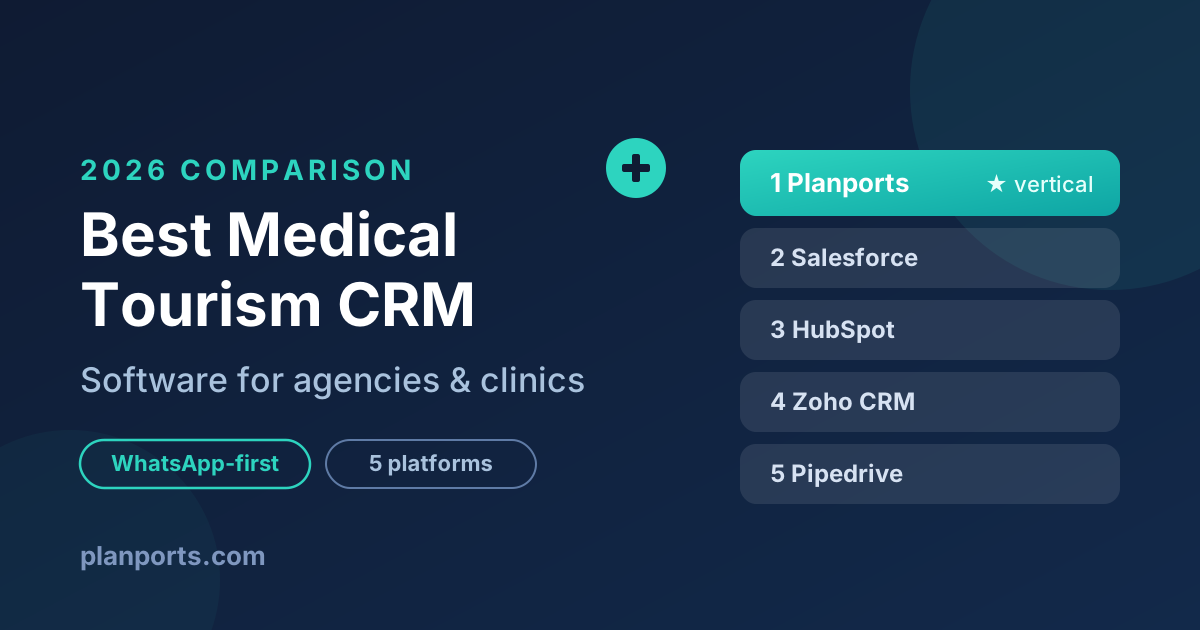
A medical tourism sale looks nothing like a typical B2B deal. The lead arrives from a Facebook ad in one country, asks questions on WhatsApp in another language, compares clinics for weeks, then needs flights, transfers, treatment scheduling and aftercare follow-up. That journey involves coordinators, doctors and translators — and it lives almost entirely in messaging apps.
Ordinary CRMs treat this as an afterthought. The result: conversations trapped in personal phones, leads lost between staff shifts, and no visibility into which country or campaign actually produces patients.
Planports Medical & Health Tourism CRM is a vertical solution: WhatsApp Business API and Instagram DM are built in, leads from ads and forms land in one inbox, and the pipeline is designed around treatment stages. Quoting, bulk WhatsApp campaigns, workflow automation and coordinator task management come out of the box, with a 14-day free trial and per-user pricing.
Strengths: WhatsApp-first design, fast setup (days), health-tourism workflow without custom development, responsive support.
Considerations: Focused on SMB agencies and clinics rather than hospital-group enterprise IT stacks.
The most powerful and customizable platform on the market. With enough budget and development resources, Salesforce can model any workflow — including medical travel. The trade-off is cost and complexity: implementation is a project, WhatsApp requires third-party connectors, and per-user pricing at useful tiers is among the highest.
Excellent marketing automation and a generous free tier. For medical tourism specifically, the patient-journey and WhatsApp side needs add-ons and custom properties; costs rise quickly as contact lists and feature needs grow. A strong choice if inbound content marketing is your main engine. (See our detailed Planports vs HubSpot comparison.)
Affordable and broadly capable, with a large ecosystem. Like HubSpot, it is a horizontal CRM: WhatsApp and health-tourism workflows are assembled from extensions and custom modules, which takes configuration time and technical comfort.
Loved for its clean pipeline view and ease of use. It suits small teams tracking straightforward deals; for messaging-heavy patient coordination, multi-channel intake and quoting, expect to lean on integrations.
A newer CRM built specifically for dental tourism, with an interactive tooth chart, multi-visit treatment plan builder and AI-drafted WhatsApp replies (from $59 per user per month on its Capterra listing). It suits a single dental clinic that wants clinical planning inside the CRM; agencies and multi-specialty clinics will want broader channel and team features. See our Planports vs DentClosers comparison.
| Platform | Patient pipeline | Setup speed | Best for | |
|---|---|---|---|---|
| Planports | Native (API) | Built in | Days | Agencies & clinics |
| Salesforce | Via connectors | Custom build | Months | Hospital groups |
| HubSpot | Add-ons | Custom properties | Weeks | Marketing-led teams |
| Zoho CRM | Extensions | Custom modules | Weeks | Budget all-rounder |
| Pipedrive | Integrations | Sales stages only | Days | Simple sales teams |
Start from your communication reality, not the feature list. If your patients message you on WhatsApp — and in medical tourism they almost always do — a WhatsApp-first vertical CRM will produce value in the first week, while a horizontal platform is still being configured. If you are a hospital group with an integration roadmap and an IT department, enterprise platforms earn their complexity.
Whichever you choose, insist on a real trial with your own inquiries: connect a number, route one campaign, and watch whether leads actually get answered faster.
There is no single "best CRM" — there is the best fit for how your patients communicate. For WhatsApp-driven medical tourism agencies and clinics, that fit is a vertical, messaging-first platform. Explore how Planports for medical & health tourism handles patient coordination end to end, or start a 14-day free trial and test it with live inquiries.
It depends on your size and workflow. Agencies and clinics that live on WhatsApp typically get the fastest results from a vertical solution like Planports, which combines WhatsApp Business API, a patient-journey pipeline and quoting in one platform. Large hospital groups with dedicated IT teams may prefer heavily customized enterprise platforms like Salesforce.
International patients rarely call or email — they message. Treatment questions, travel logistics, photos and follow-ups all happen on WhatsApp. A CRM with native WhatsApp Business API support keeps every patient conversation attached to the patient record and lets coordinators work from one shared inbox.
Yes, with customization. They are strong platforms, but medical tourism workflows — multi-country lead intake, treatment-stage pipelines, WhatsApp-first communication and quote management — usually have to be built on top with add-ons or apps, which adds cost and setup time compared to a vertical CRM.
Most cloud CRMs charge per user per month. Entry pricing ranges roughly from $14-25 per user for affordable platforms to $80+ for enterprise tiers, plus WhatsApp Business API messaging fees. Vertical solutions bundle the health-tourism workflow so you avoid paying separately for customization.
Reputable cloud CRMs encrypt data in transit and at rest, offer role-based access and audit logs, and support GDPR-style consent management. When evaluating options, ask where data is hosted, how consent is recorded and how access is restricted per role.

Product-focused or customer-focused strategy? This question is critical for companies.

Don't know what CRM stands for or why you need it? Don't worry — you're not alone.

Cloud CRM, web-based CRM, online CRM — they all refer to the same type of software.