What is AI-Powered CRM? 2026 Guide for Small Businesses
AI lead scoring, sales forecasting, smart automation — how small businesses leverage AI CRM in 2026.
The systematic approach to converting prospects into customers: The Sales Funnel. Learn TOFU, MOFU, and BOFU stages, B2B sales funnel strategies, and CRM pipeline management in this comprehensive guide.
In 2026, competition across every industry has reached unprecedented levels. Customers are more informed, more selective, and have more options than ever before. In this environment, businesses that rely on random outreach or unstructured sales processes are falling behind rapidly. The difference between high-growth companies and stagnant ones often comes down to one thing: a well-defined sales funnel.
According to recent research, 68% of companies have not properly identified or mapped their sales funnel. This means the majority of businesses are essentially flying blind — spending marketing budgets without understanding where leads drop off, why prospects go cold, or which stages need optimization. The result? Wasted resources, missed revenue, and frustrated sales teams.
A sales funnel provides the systematic framework that transforms chaotic sales activities into a predictable, measurable, and scalable revenue engine. When paired with a modern CRM (Customer Relationship Management) system, the sales funnel becomes a living, data-driven process that continuously improves itself. Every interaction is tracked, every bottleneck is visible, and every opportunity is maximized.
In this comprehensive guide, we will cover everything you need to know about sales funnels: from the fundamental concept and stage-by-stage breakdown (TOFU, MOFU, BOFU) to the critical differences between B2B and B2C funnels, CRM-powered funnel management, essential metrics, and how Planports CRM can help you build a high-converting sales pipeline from scratch.
A sales funnel (also known as a sales pipeline, purchase funnel, or customer journey) is a visual representation of the path that potential customers take from their first interaction with your brand to the final purchase decision. It is called a "funnel" because, just like a physical funnel, it is wide at the top and narrow at the bottom — many people enter, but only a fraction convert into paying customers.
Think of it like this: Imagine you own a retail store in a busy shopping mall. Thousands of people walk past your storefront every day (awareness). Some stop to look at your window display (interest). A smaller group enters the store and browses (consideration). Fewer still try on products or ask questions (evaluation). And ultimately, only a portion of those visitors make a purchase (decision). This natural narrowing process is exactly what happens in any business — whether online or offline, B2B or B2C.
The critical insight is this: not every prospect will become a customer, and that is perfectly normal. The goal of a well-optimized sales funnel is not to convert 100% of leads (that is impossible), but to maximize the conversion rate at each stage while identifying and eliminating unnecessary friction points. A 2% improvement at each stage of your funnel can compound into a dramatic increase in overall revenue.
Modern sales funnels are far more sophisticated than the traditional linear model. Today's buyers interact with brands across multiple channels — social media, email, websites, WhatsApp, phone calls, live demos, and more. A CRM system acts as the central nervous system that connects all these touchpoints, giving your sales team a 360-degree view of every prospect's journey through your funnel.
The modern sales funnel is typically divided into three primary stages, each with distinct objectives, tactics, and metrics. Understanding these stages is essential for crafting the right message at the right time and moving prospects smoothly toward a purchase decision.
The top of the funnel is all about visibility and awareness. At this stage, your potential customers may not even know they have a problem, let alone that your product or service exists. The primary objective is to attract as many relevant prospects as possible and introduce them to your brand.
Key TOFU Tactics:
CRM Role at TOFU: A CRM like Planports automatically captures leads from Meta Lead Ads, Google Ads forms, website contact forms, and WhatsApp inquiries. Each new lead is instantly logged with source attribution, allowing you to measure which channels deliver the highest quality prospects. No lead falls through the cracks.
Prospects who move into the middle of the funnel have acknowledged their problem and are actively researching solutions. They are evaluating options, comparing vendors, and seeking proof that your solution is the right fit. This is where trust-building and education become paramount.
Key MOFU Tactics:
CRM Role at MOFU: Your CRM tracks every interaction — email opens, link clicks, demo requests, and content downloads. Planports CRM assigns lead scores based on engagement levels, automatically flagging hot leads that are ready for a sales conversation. Sales reps receive automated task reminders to follow up at the optimal time, ensuring no promising opportunity goes cold.
At the bottom of the funnel, prospects are ready to buy. They have narrowed their options and are looking for the final push — whether that is a compelling offer, pricing clarity, implementation support, or a direct conversation with your sales team. This stage is about removing the last barriers to conversion.
Key BOFU Tactics:
CRM Role at BOFU: Planports CRM provides a clear Kanban-style pipeline view where sales managers can see every deal's status at a glance. Automated alerts notify reps when a deal has been stagnant for too long. Quote generation, activity history, and team collaboration features ensure that every closing opportunity receives the attention it deserves.
While the fundamental funnel concept applies to both B2B and B2C businesses, the execution differs dramatically. Understanding these differences is critical for designing a funnel that actually works for your business model.
| Feature | B2B Sales Funnel | B2C Sales Funnel |
|---|---|---|
| Decision Makers | Multiple stakeholders (buying committee, C-suite, procurement) | Single person or household |
| Sales Cycle Length | Long — typically 1 to 12 months | Short — minutes to days |
| Average Deal Size | High ($1K – $1M+) | Low to medium ($10 – $1K) |
| Relationship Type | Long-term partnership, ongoing support | Transactional, one-time or subscription |
| Content Strategy | White papers, ROI analyses, live demos, case studies | Product images, reviews, discounts, social proof |
| CRM Necessity | Critical — complex pipeline tracking required | Helpful — simplifies campaign management |
In B2B sales, the funnel is inherently more complex. A single deal might involve presentations to multiple departments, technical evaluations, procurement negotiations, and legal reviews. Each decision-maker has different concerns and motivations. Without a CRM system to track these interactions and manage relationships across the buying committee, deals easily stall or fall apart.
B2C funnels, on the other hand, are typically shorter and driven more by emotional triggers — brand perception, social proof, convenience, and price. However, this does not mean B2C businesses do not benefit from funnel optimization. E-commerce companies that implement structured funnel analysis and CRM-driven remarketing consistently outperform those that do not.
A CRM system is the operational engine that brings your sales funnel to life. While you can conceptually design a funnel on a whiteboard, managing it in practice — across dozens or hundreds of leads, multiple sales reps, and various communication channels — requires robust software. Here are the five key ways a modern CRM like Planports transforms your sales funnel management:
Every lead that comes in — whether from a Meta (Facebook/Instagram) ad form, a Google Ads campaign, a WhatsApp message, an Instagram DM, or your website contact form — is automatically captured and entered into your CRM pipeline. No manual data entry, no spreadsheet chaos, no lost leads. Planports integrates directly with all major advertising platforms and messaging channels, ensuring every prospect enters your funnel the moment they express interest.
Your entire sales funnel becomes visible through an intuitive Kanban-style board. Each column represents a funnel stage (e.g., New Lead → Qualified → Proposal Sent → Negotiation → Won/Lost), and each card represents a deal. Sales reps simply drag and drop deals as they progress through stages. Managers get an instant, bird's-eye view of the entire pipeline — how many deals are in each stage, total pipeline value, and which deals need attention. Learn more about sales automation features that accelerate pipeline movement.
Every touchpoint with a prospect is recorded: phone calls, emails, WhatsApp messages, meeting notes, and document shares. This creates a complete history for every lead, so any team member can pick up a conversation where it left off. No more "Did anyone follow up with this lead?" or "What did we discuss in the last meeting?" — everything is logged and searchable in Planports.
Not all leads are created equal. A CRM with lead scoring capabilities automatically ranks prospects based on their engagement and fit. Factors like email opens, website visits, demo requests, company size, and budget signals are weighted to produce a score. High-scoring leads are flagged for immediate sales follow-up, while lower-scoring leads continue receiving nurture content. This ensures your sales team focuses their energy where it matters most.
You cannot optimize what you cannot measure. A CRM provides real-time dashboards and reports that answer critical business questions: What is our overall conversion rate? Where are leads dropping off? Which sales rep has the highest close rate? What is our average deal size? How accurate are our revenue forecasts? Planports offers comprehensive reporting and analytics that transform raw data into actionable insights for continuous funnel improvement.
Measuring your funnel's performance is essential for identifying weaknesses and driving improvement. Here are the six most critical sales funnel metrics every business should track:
The percentage of leads that move from one funnel stage to the next, or from initial contact to closed deal. Industry benchmarks vary, but a healthy B2B funnel converts 2-5% of top-of-funnel leads into customers.
The average number of days from first contact to closed deal. Tracking this metric helps you forecast revenue and identify stages where deals stall. Shorter cycles generally indicate a more efficient funnel.
Total marketing and advertising spend divided by the number of leads generated. Comparing CPL across channels reveals which sources deliver the most cost-effective leads for your business.
The total cost of acquiring a new customer, including marketing, sales, and operational expenses. A sustainable business model requires CAC to be significantly lower than customer lifetime value (LTV).
Measures how quickly deals move through your funnel and generate revenue. Calculated as: (Number of Deals × Average Deal Size × Win Rate) ÷ Sales Cycle Length. Higher velocity means faster revenue generation.
The percentage of customers who stop using your product or cancel their subscription within a given period. High churn indicates problems with product-market fit, onboarding, or customer success — the post-funnel stage.
Planports CRM is purpose-built to help businesses design, manage, and optimize their sales funnels — from the very first lead to the final closed deal and beyond. Whether you are a startup building your first pipeline or an established enterprise looking to streamline complex B2B sales processes, Planports provides the tools you need.
Start Free Trial → Request Demo
The sales funnel is not a theoretical marketing concept — it is the operational backbone of every successful sales organization. In 2026 and beyond, businesses that understand their funnel stages (TOFU, MOFU, BOFU), track the right metrics, and leverage CRM technology to manage their pipeline will consistently outperform competitors who rely on intuition and ad-hoc processes.
Whether you are selling complex B2B enterprise solutions or high-volume B2C products, the principles remain the same: attract the right prospects, nurture them with relevant content and timely follow-ups, and remove every barrier between consideration and purchase. A CRM system like Planports makes this process systematic, measurable, and scalable.
The data is clear: companies that formally manage their sales funnel with CRM generate significantly more revenue, close deals faster, and retain customers longer. The question is not whether you need a sales funnel — it is whether you can afford not to have one.

AI lead scoring, sales forecasting, smart automation — how small businesses leverage AI CRM in 2026.

67% of CRM users report better tracking of sales opportunities and customer leads.
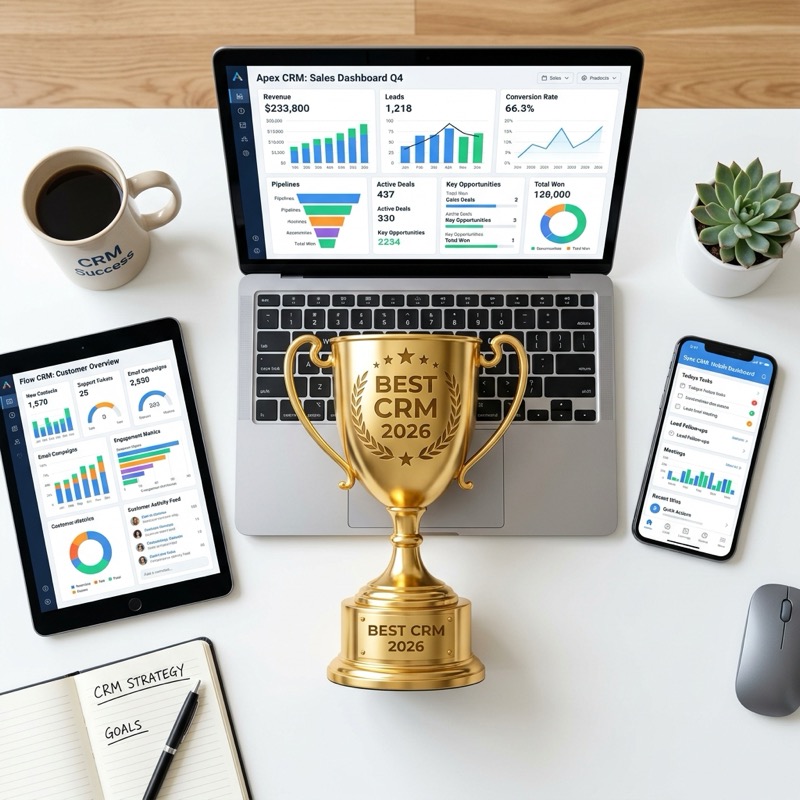
Today's best CRM software gathers customers from different channels on one platform.